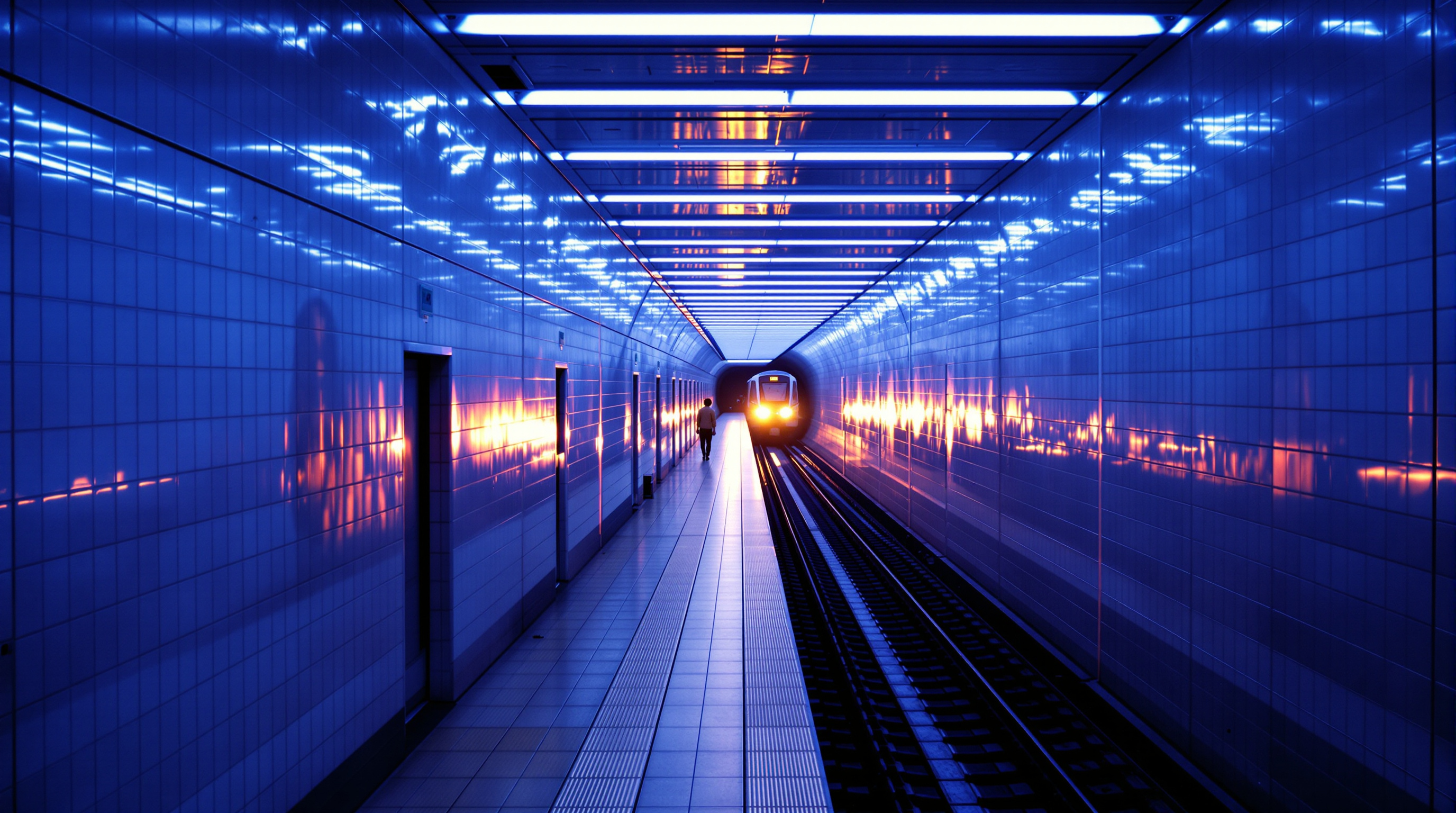
Seoul rides the subway, and so the subway is where the whole city sits together — students, grandmothers, office workers, and the last-train crowd, all in the same fluorescent room. For a photographer it is the most democratic stage in the capital.
The network is vast, clean, and relentless, moving millions a day beneath the streets; its maps and operating hours are published by the city's official visitor service. That constancy is the gift: the same platforms, the same doors, the same tidal rhythm of arrival and departure, endlessly restocked with new faces. A transit archive almost builds itself, if you learn to see it.
The platform as a set
Platforms are architecture waiting for a figure — long tiled perspectives, screen doors, repeating pillars, the head-lamp glare of an incoming train. Set up on the strong lines and wait: a single commuter against the tiled vanishing point, a crowd surging as the doors open, a lone figure held behind the glass. The light is even and bright enough to shoot handheld, and the geometry does half the work.
The carriage
Inside the trains the pictures turn human and quiet — the microsleep of the evening commute, the blue wash of a hundred phone screens, the accidental symmetry of a full bench. This is intimate ground and it asks for a gentle camera: shoot from the hip, keep the lens wide and the manner easy, and favour the frames where no one is singled out or embarrassed. Reflections in the dark window glass give you a second, softer picture of the same car.
Motion and the last train
Let the machine move for you. A slow shutter turns a departing train into a smear of light past a still commuter; a panned frame holds a face sharp against a blurred platform. Late at night the mood shifts again — the last train carries the tired and the cheerful home, and the near-empty carriages at the end of the line are their own melancholy genre. It is the natural close to a night that began at the food tents.
Manners below ground
The etiquette of the street applies underground, doubled, because the quarters are close. Keep the shutter discreet, never photograph anyone asleep in a way that mocks them, and put the camera down the instant it is unwelcome. Staff and security are reasonable if you are; large tripods and flash are not the tools for this place anyway. The point is to be a passenger who happens to have a camera, not a photographer using passengers.
The stations themselves
It is easy to spend all your attention on the people and forget that the stations are architecture worth photographing in their own right. Some are vast concrete caverns; some are bright tiled tubes; some open suddenly onto daylight and a river crossing. The transfer corridors are studies in repetition and vanishing point; the escalators stack strangers into neat diagonal rows; the exits frame a rectangle of the street above like a screen. Shoot the empty station between trains for its geometry, then wait for a single figure to give the scale a human measure. The network runs from before dawn to past midnight, and its character changes with the hour as much as any street above ground — deserted and echoing early, a crushing river of people at rush hour, tender and tired on the last train home.
The moving city
Above ground the trains climb onto the bridges and cross the Han River in the open light — the transit city and the river city briefly the same picture. The subway connects every subject in this journal; ride it between the districts and you will find that the space between destinations is, often, the best photograph of all.