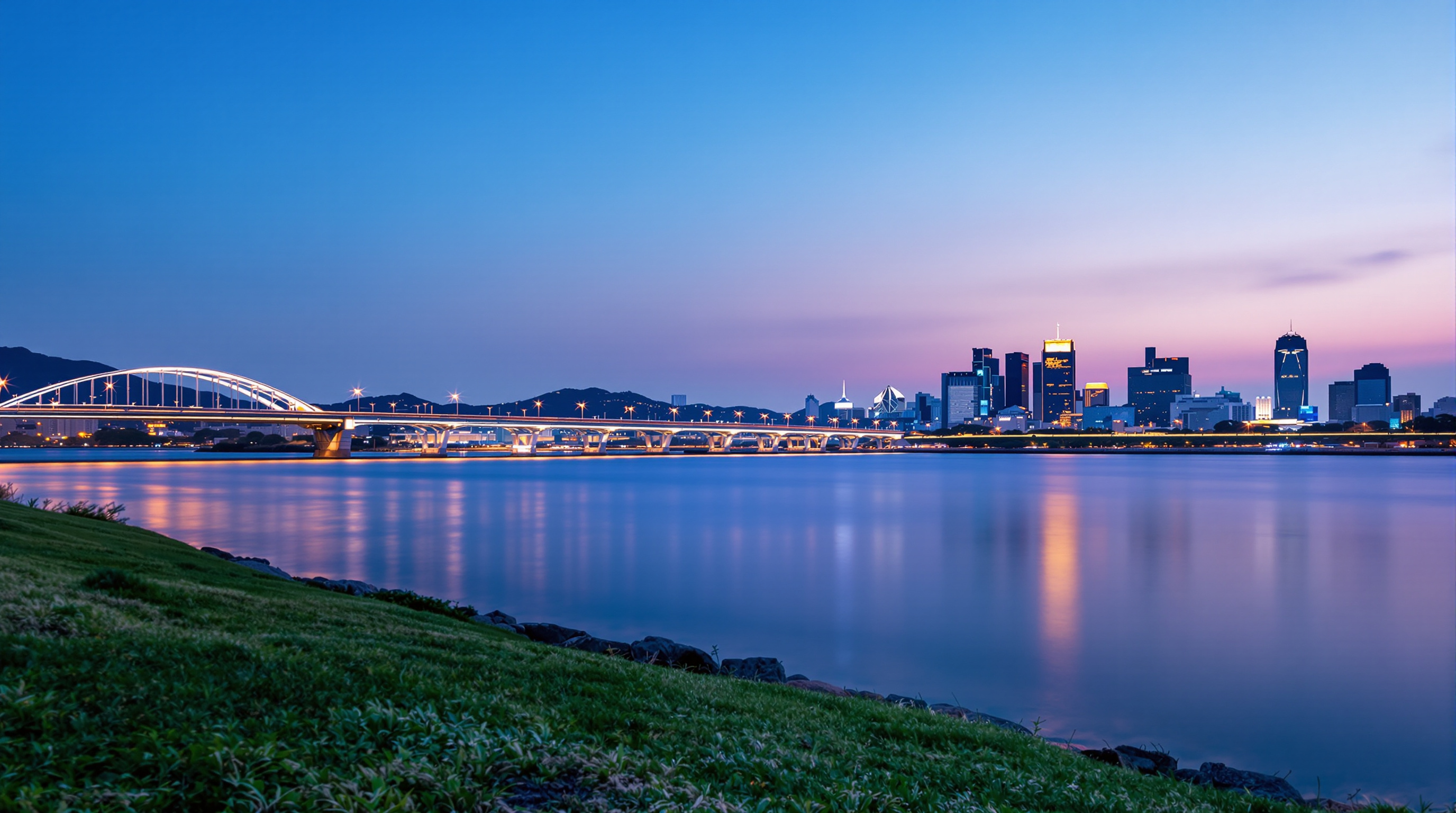
Every map of Seoul begins with the Han. The river is nearly a kilometre wide as it crosses the city, splitting it into north and south and tying the two halves together with a long procession of bridges. To photograph Seoul honestly you eventually have to photograph the water.
The Han is not a picturesque little river; it is a broad, engineered, working waterway with parks laid along both banks and expressways riding its edges. That scale is the point. Where a smaller river gives you intimacy, the Han gives you breadth, sky, and the full skyline reflected — the establishing shot of the entire city.
The bridges
More than twenty bridges cross the Han within the city, and they are the river's best subjects. At dusk they string light across the water; at night some run illuminated in slow colour; in fog they vanish by the span, receding into grey. Shoot them from the riverside parks with a long lens to compress the skyline behind, or from a bridge itself looking down the water at the others marching into the haze. The classic Han composition is simple: low horizon, a lit bridge on the thirds, the towers glowing behind, the whole thing doubled in the still evening water. For the river's place in the city's history, Encyclopaedia Britannica is a reliable primer.
The riverside parks
The banks are a continuous public park — the city's living room. On a warm evening they fill with picnics, cyclists, kite-flyers, fishermen, and couples watching the light go, and the photography turns from landscape to life. This is where Seoul relaxes, and an unguarded, generous kind of picture is available here that the busy streets rarely give up. Delivery scooters bring dinner to the grass; tents and mats spread to the waterline; children chase the last of the light. Keep the camera low and let the people be small against the big water.
Light and weather on the water
The river is an open stage with nothing to block the sky, which makes it the best place in the city to shoot weather. Sunset runs long and unobstructed; storms build in full view; the monsoon turns the surface to hammered pewter. Winter can freeze the shallows and lift mist off the channel at dawn. Because the water reflects, the river doubles whatever the sky is doing — so the move is to watch the forecast and be on the bank when the sky performs.
North bank, south bank
The two banks of the Han photograph differently, and it is worth knowing which you want before the light goes. The northern side looks across to the older city and the mountains behind it, so its pictures carry history and skyline together; the southern side faces the newer towers, so its frames run cooler and more corporate, all glass and repetition. The bridges between them are the neutral ground — shoot from one bank toward the other and you get the full width of the river with the city stacked behind. On a still evening the water holds a near-perfect mirror; on a breezy one it breaks the reflections into a shimmer of colour. Either is good; they are simply different pictures, and the river gives you both within a single walk.
The city's spine
Follow the Han and you understand the map: the historic districts to the north, the towers to the south, the mountains standing over both. It is the thread that connects every other subject in this journal — the seasons play out along it, the bridges carry the trains across it, and the best hilltop views in the photographer's guide are really views of the river holding the city together.